bradmook.com
Noticing. Collaborating. Improving.
Monthly Archives: June 2011
Culture as a Cornerstone
Posted by on June 28, 2011
I am always amazed that corporate culture is such an afterthought for most companies. I’ve studied hundreds of companies as an equity analyst, and worked at a few Wall Street firms along the way. A small percentage of companies understand the value of culture, but most don’t.
One company that does seem to get it is Netflix. A remarkable success story, Netflix disrupted the well-established video rental business and almost single-handedly buried Blockbuster. Over the past five years, it has tripled sales, more than quadrupled earnings, and seen its stock price increase more than ten-fold. Whether or not it continues to thrive over the next five years, its recent rise has been impressive.
 Netflix’s co-founder and CEO, Reed Hastings, treats culture as a cornerstone in the company’s success. A while back, he shared a slide deck discussing the company’s thinking around culture. The deck, titled “Reference Guide on our Freedom & Responsibility Culture” and found below, is 128 pages long, but it’s an easy read and well worth flipping through and contemplating if you have a few minutes.
In the deck, Hastings has a list of nine “behaviors and skills” that Netflix values in its colleagues, and in no uncertain terms declares “We Want to Work with People Who Embody These Nine Values”.
They are:
• Judgment
• Communication
• Impact
• Curiosity
• Innovation
• Courage
• Passion
• Honesty
• Selflessness
I doubt that anyone would argue that these nine traits are counter-productive. A team is not likely to function at a higher level by including people who have poor judgment, lack courage, or are dishonest. I don’t know if these particular traits are the most important ones (I am an enthusiast, not an absolutist), but I’d suggest they are among the characteristics shared by most high-performing organizations. I’d also suggest they have greater impact when serving as cornerstones than when used as accent pieces.
Think for a minute about your life and the company you keep. Consider whether you or not exhibit these—or similar—traits. What about your co-workers…friends…family?
I think we can raise our individual and collective performance by weaving these cultural elements into our day-to-day lives and decisions. As you structure your relationships—with colleagues, business partners, friends, neighbors, family members, etc.—strongly consider what behavior you are reinforcing and what that means for your expected outcome.
Taking Stock
Posted by on June 19, 2011
One of the best things about Father’s Day, as with a birthday or New Year’s Day, is that it serves as a mile post for measuring progress. It leads me to think about where I was a year ago and what has changed. Given that one of my overarching themes through life is the idea of making net progress each day, those little incremental steps should have added up to material change over the course of a full year. Each of those years of progress should then add up to even bigger change…positive change…over a lifetime.
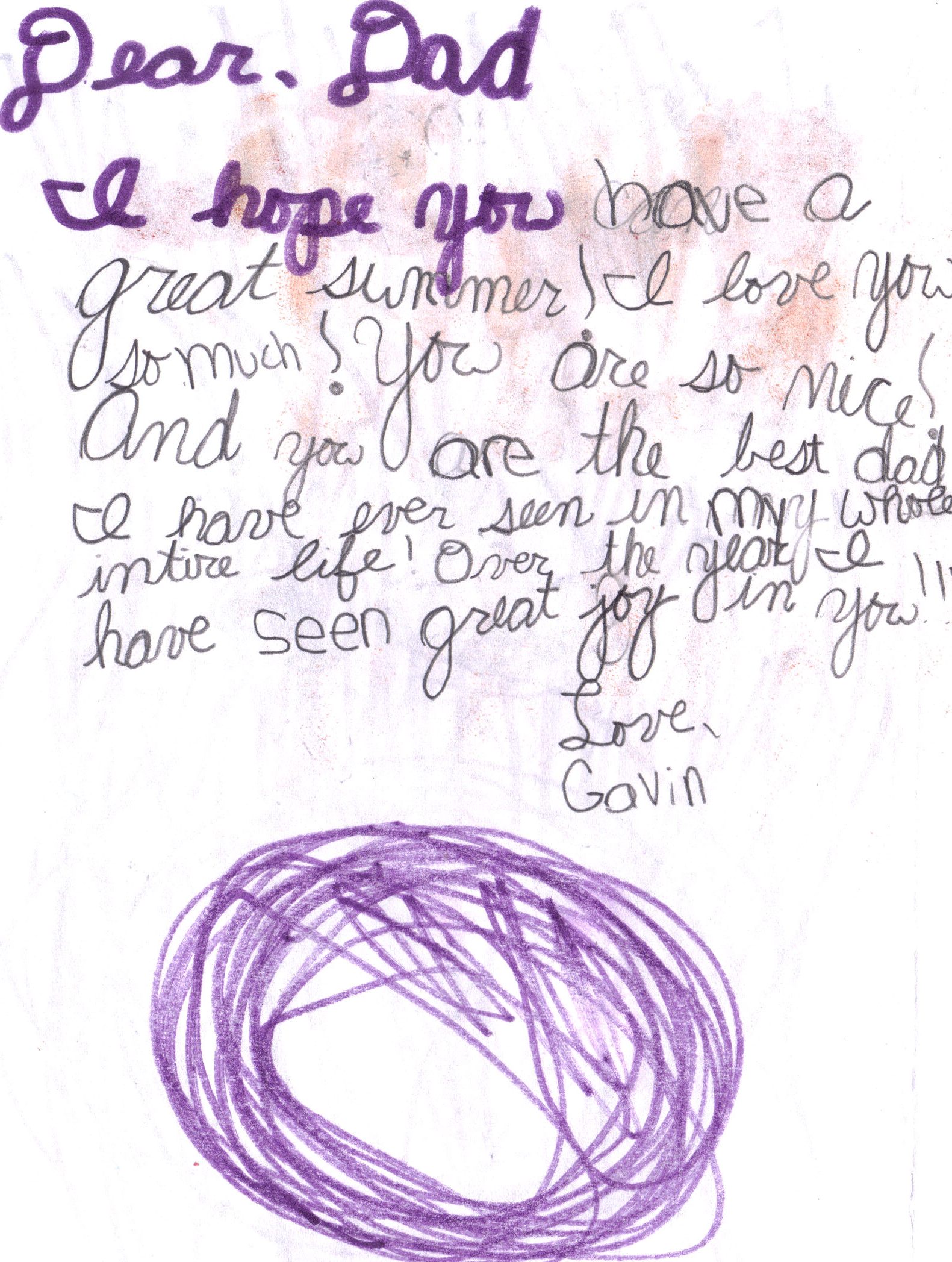
(He's still working on his handwriting, but the message couldn't be better.)
This Fathers Day, I was perhaps spared a lot of introspection when I read my seven year-old son’s card. In it, he wrote “Over the year I have seen great joy in you”, and explained that I seem happier and yell less. I don’t know that this is definitively true, but I suppose there’s no more pure gauge than the perception of a child. And it is really gratifying to think that the positive change that I’ve been trying to achieve has translated into a better relationship with my son.
So as I reflect on the past year and look forward to the next, I feel like I’m on the right track. I’ll still make my mistakes, and certainly still have my character flaws, but little by little I am focusing on adding productive, fulfilling activities and crowding out unproductive and unsatisfying ones. I feel good about my family, my career, my health and my social life, and I am really excited for the year ahead. It really is a Happy Father’s Day.
And Gavin…I love you so much, too.
It’s All in Your Head
Posted by on June 11, 2011
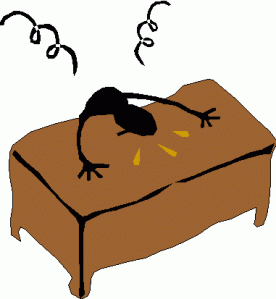 It boggles my mind how wrapped up in conflict people can become and how much they let others get in their head.
Over the past few months I’ve had several conversations with friends and associates in which they have repeatedly complained about the behavior of others. Some of these people are negative or critical by nature, so complaining is par for the course. Others, however, are introspective and thoughtful, and have fully considered their own role in their situation before finally casting blame.
In each case I’ve either agreed or disagreed with their premise, but in all cases I’ve tried to talk them off the ledge. In general, I think life’s too short to waste negative energy worrying about the actions of others. Doesn’t mean we have to like their behavior, but it does mean understanding that their motivations (and awareness) are different from ours and choosing to focus on our own actions instead. Getting caught up in others’ actions can adversely affect our own intentions; at a minimum it distracts us, but more likely we start managing to a different set of objectives. We start playing defense instead of offense, and it’s tough to make progress on our heels.
Stepping back and noticing these friends and associates letting others get in their heads has opened my eyes. I’ve started looking for evidence of this in my own life…situations where I am wasting energy focusing on the wrong things. It’s much easier said than done, but it’s a worthwhile exercise. I am also becoming a better “life coach”, helping my peers see through their aggravation and focus on their goals. It’s up to them whether they want to rise above it or not, but at least by redirecting the conversation I can show them another path.
Ultimately, the only one that should be in your head is you. And that’s a choice.
The Wake Effect
Posted by on June 4, 2011
I have an eleven month-old daughter, Delaney, who has hit the home-wrecking stage. She is into everything, newly mobile and intensely curious. Over the course of a half hour…let alone an entire day…she leaves a path of destruction around the house. Toys are scattered, cabinets (the safe ones) are emptied, and anything we’ve left within reach is handled and discarded.
 It’s been a few years since my other children were in this stage, but even the older ones can leave a trail. At this point we’re working on chores and allowances, trying to develop a sense of responsibility and contribution in each of them. Some weeks are better than others; lately it seems we’re back at square one. This morning when I got up there was stuff everywhere, which is what happens when people continue to make a mess and not clean up after themselves.
A personal mission of mine is to not leave a trail behind me. I try to be disciplined about picking up after myself and not leaving a wake. And often as I move about through the house I will try to chip away at whatever mess is there. It’s part of my net progress philosophy, that consistent incremental progress adds up…eventually cleaning up my own mess plus a little bit of others’ will eventually get rid of the mess. Of course, with Hurricane Delaney in the house there is always a mess to clean up.
I think what applies in our household also applies in the world. If everyone could avoid leaving a wake, and perhaps even chip away at the mess by cleaning a little more than their mess, the world would be in a great place. Too often people lose sight of their impact and leave a mess for someone else, and the cumulative impact is substantial. The trick is to subtly flip the equation and have that cumulative impact be positive. And even if we can’t change others’ behavior, we can have an impact by changing our own. And that’s why I keep chipping away and remaining hopeful. Maybe someday our house…let alone the world…will become a “no wake zone”.
 bradmook.com