bradmook.com
Noticing. Collaborating. Improving.
The Importance of Course Correction
Posted by on September 14, 2013
A big underlying principle in my life is incrementalism. I often explain this as the single footstep phenomenon, where putting one foot in front of the other over time covers a lot of ground. This is true literally…I run, and once in a while look over my shoulder and am surprised at the ground I’ve covered…as well as figuratively. Stringing school days together educates children. Stringing productive workdays together builds a successful career. Stringing workouts together creates fitness.
 It’s important, however, to keep an eye on the big picture. This can be hard to do if you’ve always got your head down focusing on the task at hand. This is commonly known as “getting lost in the weeds”, and is usually followed by that “Oh crap, how did I end up over here” moment. The key is to pick up your head along the way once in a while to keep some context and gauge the appropriateness of your daily activities. If you see you’re off track, course correct and head in the right direction…before the cost of recovery is too high.
Yesterday we had a breakthrough course correction at Baby Be Hip, and it was awesome. Not so much realizing that we had been marching in the wrong direction (no one likes to waste effort or money, especially when we should have known better), but identifying the mistake and heading in the right direction was empowering. Now, with the help of a promising new partner (shout out to Mark Kennedy of SEOM Interactive, who is helping us pivot our search marketing strategy), we know we’ll be in a better position to increase our relevant traffic and drive more revenue.
Take a few moments this weekend or in the week ahead to make sure your daily activities are aligned with your bigger goals. If they are, forge ahead! If not, take the opportunity to redirect them so they point to your objective. While the winding road may be interesting, it is not the most efficient. After all, the shortest distance between two points is a straight line.
Fathers’ Day
Posted by on June 16, 2013
It’s Fathers’ Day, and I am waking up in the hospital with my daughter Ellie. Her roommate started fussing in his high-pitched voice around 5:30, which jolted my day into motion. It is only a matter of time before he wakes my daughter. My family will join us in a few hours, and we’ll celebrate by having brunch in the hospital cafeteria.
This isn’t the Fathers’ Day you seen in cards or on commercials, at least this part of the day. No breakfast in bed or golf here. Yesterday we heard an ad that said that Fathers’ Day is about sleeping in, good food, and family. I didn’t get to sleep in, and my breakfast will be institutional grade. But…my family will be awesome, and that part of the day started when I sat up and saw Ellie.
Ever since I became a dad, I’ve wrestled with what to do with Fathers’ Day. Is it a day for me, a “day off” when I can relax and do some of the things I’ve put off because I’ve been changing diapers and helping with homework and coaching youth sports? Or is it a day for the kids, an opportunity for me to show them how important they are by giving them my undivided attention for once? The yin-and-yang of the day has always made me a bit uncomfortable.
On this particular day, however, I begin the morning as the caring and responsible parent of a child in need. Granted, this is a role my wife plays regularly, and I am merely the weekend substitute. I take no special credit. But I do take great comfort in the notion that I am doing what I am supposed to be doing as a dad. I am being the best dad I can be, and that’s a great way to start Fathers’ Day. I can’t wait till she wakes up, looks over, sees me and smiles.
Dropping the Plow
Posted by on December 30, 2012
Last night I lay awake at my parents’ house listening to the snowplow service unnecessarily clear half an inch of snow from their driveway, and it got me thinking about misalignment of incentives. The guy who drives the plow is trying to maximize his earnings, so he wants to get paid in frequency and magnitude. He’ll charge as much as he can get away with and he’ll come as often as he can, whether he’s needed or not. Instead of calling to see if they want it cleared, he’ll show up to clear half an inch after midnight when everyone’s in bed and not inclined to chase him away. He’s actually incentivized NOT to talk to his customers, because it’ll likely result in less work.
I have a similar issue with my lawn service, who will come and cut even if it’s a drought and the grass hasn’t grown. He cuts, he charges, I pay…until I push back. Eventually he may get fired, and replaced by the next guy who’s $10 cheaper and won’t push his luck until the next season.
I’m not sure how to align the incentives in this case, but I am convinced that better communication would produce happier customers and more profit in the long run. Any time the customer grows to resent the vendor it can’t be good for business. Something to keep in mind as you go about your own business…are your customers happy, or are you just capitalizing on the relationship until they inevitably move on?
Fairness and Taxes
Posted by on November 29, 2012
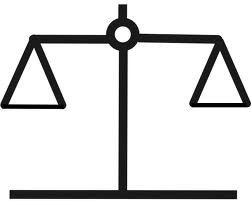 As our nation’s political leaders wrestle with our debt and deficit, and more immediately the looming fiscal cliff, we hear a lot of opinions about what to do with tax policy. Setting aside the debate on whether we should be raising taxes or cutting spending, nearly everyone agrees that our existing tax policy is a mess and needs to be “fixed”. Of course, opinions are all over the place with respect to the solution, i.e., what “fixing it” really means.
I am optimistic that–despite their ideological posturing–our elected representatives will come to a workable agreement that allows the gears of our economic engine to keep turning. To quote Michael Goldstein (11/28/12), “The most likely outcome from the fiscal cliff deliberations will be a partial, stopgap measure that marginally reduces the deficit. While that result won’t satisfy some observers, incrementalism is probably the best course of action.”
My angst with the situation is less about the mechanics of resolution and more about the philosophical underpinnings. We hear a lot about the rich needing to “pay their fair share”, which is a loaded statement if ever there was one. How do we define “fair share”? Before we make policy decisions based on such rhetoric, we need to agree on the fundamental definition of fairness.
The Declaration of Independence states that all men are created equal. Based on that very simplistic notion, one could argue that the most basic definition of fairness is sameness; that is, everyone is equally responsible. Thus, each citizen should pay an equal dollar amount. This, however logical, is not practical. Each person has a different starting point, and unless we are going to lobby for equal starting points (road to communism) we have to make an allowance for that. So perhaps an proportionate system—i.e., an equal rate, or flat tax—is appropriate, as it would call on each of us to contribute to the same proportion of our income to the common good. To me, that seems fair.
The system we have today, though, is a progressive tax (the more the income the higher the rate). The notion of a making our progressive tax system incrementally more so in the name of “fairness”—which seems to be where we’re headed—is problematic. In essence, it implies a definition of fairness where everyone contributes as much as they have until everyone is left with the same amount. You make less than x—a basic poverty line, below which we provide a safety net—you pay nothing and receive entitlements that provide you with x. You make 2x, and you pay 1x so you’re left with 1x (i.e., a 50% tax rate). You make 10x, you pay 9x so you’re left with 1x (i.e., a 90% tax rate). You make 1.25x. you pay 0.25x (20% tax rate). Now everyone has x and that, it could be said, is fair. But it fails to explain why it is fair for one person to pay 90% of their income while another pays 20% of theirs when they consume similar amounts of the public infrastructure. Even at a flat rate, one is paying a much higher dollar amount.
Tilting the progressive system not only stretches the concept of fairness (at least how I see it), but it reduces the incentive system that makes capitalism work. If the government is going to legislate outcomes, which is what it is doing with raising rates on the rich, then it exacerbates the free rider problem and shrinks the size of the pie. And that contradicts the superior objective of stimulating economic growth.
I don’t have the answer, and neither does anyone else. But what I do know is that we need to agree on a conceptual definition of “fairness” before we take people’s money disproportionately and claim the moral high ground. The solution I’m most comfortable with at this point is a flat tax for anyone beyond a basic poverty threshold. Set a floor, set a rate, and move on to solving the knock-on implications for the spending side of the budget.
New (Years) Attitude
Posted by on January 1, 2012
Happy New Year! Wishing everyone a happy, healthy and prosperous 2012.
Much like many other people, New Years Day is one of my favorite days of the year. I love the freshness that it introduces, the opportunity to reset the clock. While cynicism tends to reign as years wind down, optimism takes over on New Year Day and sticks around for a few weeks.
Over time, my New Years Day philosophy has evolved. I used to make resolutions, but it didn’t take long to realize that they are short-lived. I started making goals; instead of saying I’m going to do more of X or less of Y, I now say I’m going to accomplish Z. Then I just do what I have to do to accomplish it. Two years ago I resolved to work out more, but that was too wishy-washy. Last year I set the goal to work out 120 times in 2011, and I did 131 times. Setting goals works.
This year, I am taking it a step further. I have set new goals for 2012 (work out 150 times), but I am also deciding what I want the year to look like. At New Years, we are quick to judge the year gone by (it was a good one); I want to pre-judge the year ahead (it will be a great one).
We never truly know what’s in store for us, so we can’t accurately script the year ahead. But I am very excited to chart its course with a mixture of goals and attitude. I have a vision for where I want my life to go, I am determined to get there, and I couldn’t be more excited about it.
Decide what you want your year to look like next New Years, and make it happen. Carry the New Years optimism with you all year, and make the today’s hope your permanent reality.
Diversity of Experience
Posted by on October 23, 2011
I’ve generally had enough of the ubiquitous Steve Jobs worship over the past few weeks, but there was one quote of his that got my attention:
“A lot of people in our industry haven’t had very diverse experiences. They don’t have enough dots to connect, and they end up with very linear solutions, without a broad perspective on the problem. The broader one’s understanding of the human experience, the better designs we will have.” ~ Wired, February, 1996
I think the quote comes to life through another quote of his, in reference to Bill Gates:
“I wish him the best, I really do. I just think he and Microsoft are a bit narrow. He’d be a broader guy if he had dropped acid once or gone off to an ashram when he was younger.” ~ The New York Times, January 12, 1997
Upon reflection, I may be more Bill Gates-like than Steve Jobs-like (not a big surprise for those that know me). That doesn’t make my accomplishments any less worthwhile, but it can teach me something about myself. I’m a creature of habit, preferring familiar surroundings and circumstances to unfamiliar ones. As such, I probably tend to be less adventurous (and perhaps creative) than I otherwise might. And I’ve been okay with that, under the premise that I can have a perfectly happy and fulfilling existence and let my boundaries expand naturally on the margin.

Scottsdale, November 2009. Hiking Camelback Mountain was more impactful than sitting by the pool.
Lately, as I’ve become more aware of my own tendencies and confident in my own skin, I have attempted to push my boundaries a bit more aggressively. I’ve done this by taking on commitments that stretch my comfort zone, particularly in areas where I’d like to expand my skills and, well, comfort zone. Not by dropping acid or running off to an ashram, mind you, but trying new things related to my everyday life and raising the bar for myself.
Now, thanks to Jobs’ quote, I better understand the value in trying new things. It’s not in becoming something different, but in making the existing better. And that’s something I strive to do all the time.
Now, with greater awareness and purpose, I can make a conscious effort to add more dots to connect and broaden myself. Join me.
Ellie’s New Friend Chris
Posted by on August 15, 2011
Every once in a while life throws you a signal, a little nugget of wisdom to remind you of your purpose and help you to a better outcome. Sometimes these nuggets are subtle and easily overlooked. Sometimes they’re obvious, literally blocking your path so you can’t miss them.
My family had one of the more obvious kind today. We were walking on the boardwalk, my wife and I each pushing a stroller and our two older children riding their bikes. Our five-year old daughter Ellie was in the stroller I was pushing, actually a cross between a stroller and a wheelchair. Ellie has special needs, and one of them is to be pushed around since she can’t really walk. She has other issues as well, such as being non-verbal; she is severely developmentally delayed.

I didn't even see Chris' Superman hat until I saw the picture later.
During our walk today, a man approached Ellie and me as we were walking and said, “Excuse me, sir, could you tell me what’s wrong with your daughter?” He caught me off guard; I didn’t recognize him, he seemed a bit off balance and his speech was slow and a bit slurred. Also, while Ellie doesn’t look “typical” people generally aren’t sure enough (or bold enough) to ask so directly. However I stopped and briefly explained her situation and, when I finished, he leaned forward and started speaking to her directly.
The man looked her in the eye and told her to never give up, to always be determined. He explained to her that he had had an accident and was told he would not live, let alone walk or talk again. He told her he was determined not to give up, but rather to fight his way back. I think he teared up a little as he instructed her to stay strong and to work to overcome her challenges.
As he stood up we thanked him for his message to Ellie and introduced ourselves, and asked him for his story. He said his name was Chris, and that four years earlier he had had a stroke. Apparently the hospital had given him an overdose of medication that put him in a coma and should have resulted in his death, or at best a permanent vegetative state. Instead, he fought his way back and four years later was on the boardwalk smiling and giving Ellie a pep talk.
We said goodbye and parted ways, strangers in a big world that had crossed paths for just a brief moment in time. The fact that Chris approached us and spoke directly to Ellie so deliberately tells me that the encounter was more than just a coincidence. I think it was one of those signals, a reminder to all of us to face our challenges head on and not give up. And seeing Chris speaking to Ellie, the two of them knowing more hardship than the rest of us observing, was humbling. I have little to complain about, and my challenges are minor. The least I can do is keep my chin up and do my absolute best.
Thank you, Chris, for cheering on my Ellie and for teaching me something today.
The Airlines Still Don’t Get It
Posted by on July 25, 2011
I’m often struck by inefficiencies where they clearly don’t belong. Yesterday, while waiting for boarding to begin on my flight from Philadelphia to Atlanta, the boarding crew announced the flight would be totally full and asked for volunteers to check bags for the flight. If not, they warned, it would be very likely the passengers in the final boarding zone would have to have theirs checked. No one moved.
The problem, of course, is that there is absolutely no incentive for anyone to comply with the employee’s request. The passengers early in the boarding series are likely to get overhead space, so they have no reason to check their bag. The passengers late in the boarding cycle may not get overhead space, but the downside to carting their bags on the plane and finding no room is no worse than checking the bag to begin with. So complying with the gate agent’s request to check the bag just locks in the downside risk.
Obviously it’s in the airlines’ interest to get this right. Smoother boarding means quicker departures, which probably means better on-time statistics and better plane utilization. The airlines could make the equation more interesting by offering disincentives; bags will be chosen to be checked at random or by some system (such as every fifth passenger’s bag) and charged the $25 baggage fee. That way customers might opt to check their bag for free voluntarily rather than risk the fee. And it would spread the risk across all the passengers, not just sticking it on the unlucky ones late in the boarding series. But people would probably cry foul.
A better option might be to offer a free in-flight perk to passengers that volunteer, such Wi-Fi or a meal. That wouldn’t set the airline back much (especially not the Wi-Fi, which carries little or no incremental cost) but would likely expedite the boarding process on a crowded flight and make for happier passengers.
It’s hard to believe an industry that has been at it for decades and has such a repetitive, high-volume process just can’t get things like this right.
Culture as a Cornerstone
Posted by on June 28, 2011
I am always amazed that corporate culture is such an afterthought for most companies. I’ve studied hundreds of companies as an equity analyst, and worked at a few Wall Street firms along the way. A small percentage of companies understand the value of culture, but most don’t.
One company that does seem to get it is Netflix. A remarkable success story, Netflix disrupted the well-established video rental business and almost single-handedly buried Blockbuster. Over the past five years, it has tripled sales, more than quadrupled earnings, and seen its stock price increase more than ten-fold. Whether or not it continues to thrive over the next five years, its recent rise has been impressive.
 Netflix’s co-founder and CEO, Reed Hastings, treats culture as a cornerstone in the company’s success. A while back, he shared a slide deck discussing the company’s thinking around culture. The deck, titled “Reference Guide on our Freedom & Responsibility Culture” and found below, is 128 pages long, but it’s an easy read and well worth flipping through and contemplating if you have a few minutes.
In the deck, Hastings has a list of nine “behaviors and skills” that Netflix values in its colleagues, and in no uncertain terms declares “We Want to Work with People Who Embody These Nine Values”.
They are:
• Judgment
• Communication
• Impact
• Curiosity
• Innovation
• Courage
• Passion
• Honesty
• Selflessness
I doubt that anyone would argue that these nine traits are counter-productive. A team is not likely to function at a higher level by including people who have poor judgment, lack courage, or are dishonest. I don’t know if these particular traits are the most important ones (I am an enthusiast, not an absolutist), but I’d suggest they are among the characteristics shared by most high-performing organizations. I’d also suggest they have greater impact when serving as cornerstones than when used as accent pieces.
Think for a minute about your life and the company you keep. Consider whether you or not exhibit these—or similar—traits. What about your co-workers…friends…family?
I think we can raise our individual and collective performance by weaving these cultural elements into our day-to-day lives and decisions. As you structure your relationships—with colleagues, business partners, friends, neighbors, family members, etc.—strongly consider what behavior you are reinforcing and what that means for your expected outcome.
Taking Stock
Posted by on June 19, 2011
One of the best things about Father’s Day, as with a birthday or New Year’s Day, is that it serves as a mile post for measuring progress. It leads me to think about where I was a year ago and what has changed. Given that one of my overarching themes through life is the idea of making net progress each day, those little incremental steps should have added up to material change over the course of a full year. Each of those years of progress should then add up to even bigger change…positive change…over a lifetime.
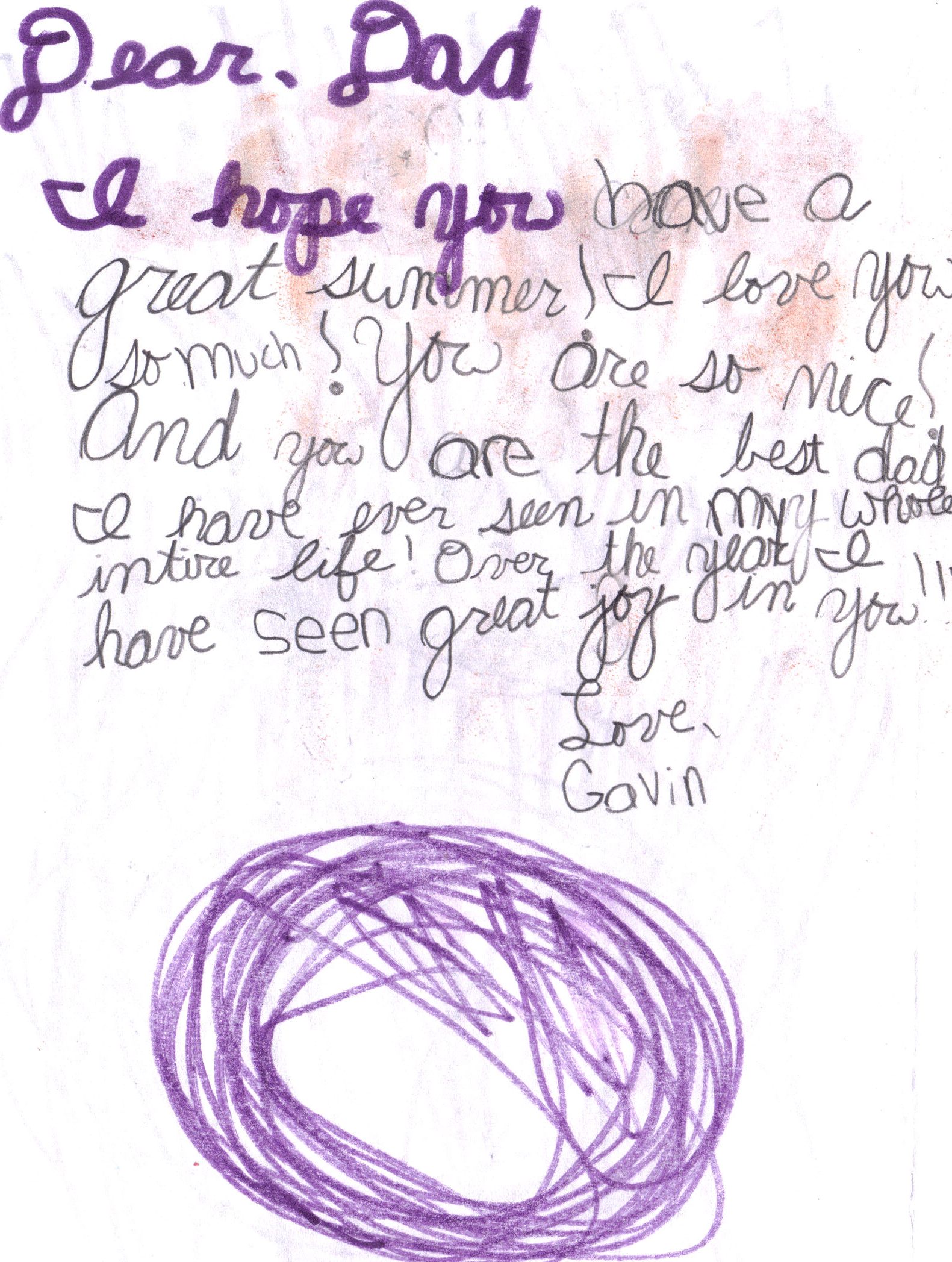
(He's still working on his handwriting, but the message couldn't be better.)
This Fathers Day, I was perhaps spared a lot of introspection when I read my seven year-old son’s card. In it, he wrote “Over the year I have seen great joy in you”, and explained that I seem happier and yell less. I don’t know that this is definitively true, but I suppose there’s no more pure gauge than the perception of a child. And it is really gratifying to think that the positive change that I’ve been trying to achieve has translated into a better relationship with my son.
So as I reflect on the past year and look forward to the next, I feel like I’m on the right track. I’ll still make my mistakes, and certainly still have my character flaws, but little by little I am focusing on adding productive, fulfilling activities and crowding out unproductive and unsatisfying ones. I feel good about my family, my career, my health and my social life, and I am really excited for the year ahead. It really is a Happy Father’s Day.
And Gavin…I love you so much, too.
 bradmook.com